 I'm inspired by Liz Wiseman's RootsTech talk for integrating two of my passions: helping rookies grow and exploring genealogy. If you missed her RootsTech session, you can purchase her session or read her book.
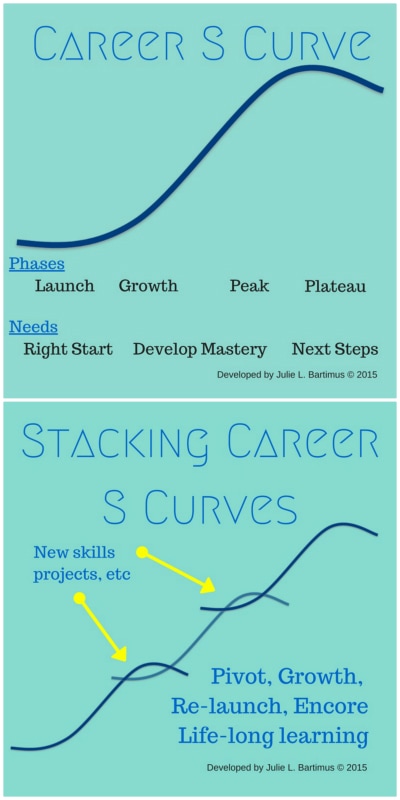
If you want to learn a little more about the Career S Curve she discussed, read on. Career S Curves give us a generalized view of career growth over time. The figure on the right shows the launch, growth, peak, and plateau of a career. And, while this overly generalized view of a career may fit with our idea of the launch of a young professional's career after graduation, the growth through subsequent positions, the later peaking of performance and productivity, and the plateau as someone heads into retirement, the large curve is comprised of smaller curves. A new curve starts as someone takes on new skills, projects, or jobs. As someone progresses through the Career S Curve, their needs change. At the launch of a career or new Career S Curve, the professional is looking for guidance and information to help them "Right Start" effectively. As Liz mentioned, we are "rookies" making guesses and moving forward based on the situation and available information. Hearing what has worked well for others and what hasn't provides some of this guidance. Understanding best practices and trends keeps a professional on track. This information is available by networking through professional groups and within our employers, in person or online. As the career or new skill is growing the focus is on developing mastery in the field or with the specific skill. Professionals need support, guidance, and direction as they work towards an objective and develop competency. This assistance can come from supervisors, team members, mentors, or coaches. Anyone who is further along the S Curve can provide information and assistance. As a person nears or achieves peak performance, they should be looking at next steps, new projects, or new skills to pursue. This way, a new S Curve starts and the career continues to progress. As a professional is plateauing in one set of skills, they should always be launching a new curve in another set of skills. This transition has different names depending on when they occur and their complexity. Pivot and re-launch are used for mid-career professionals. Encore Career has been popularized with professionals in their 50's and 60's. Additional information is available in recorded mini-Webinars on Being and Mentor and Being a Mentee near the bottom of the Mentoring 101 page]. ~~~~~ I originally wrote parts of the post for the University of Illinois Alumni Career Center blog.
0 Comments
Leave a Reply. |
AuthorJulie L. Bartimus, 
Archives
May 2021
Categories
All
|
 RSS Feed